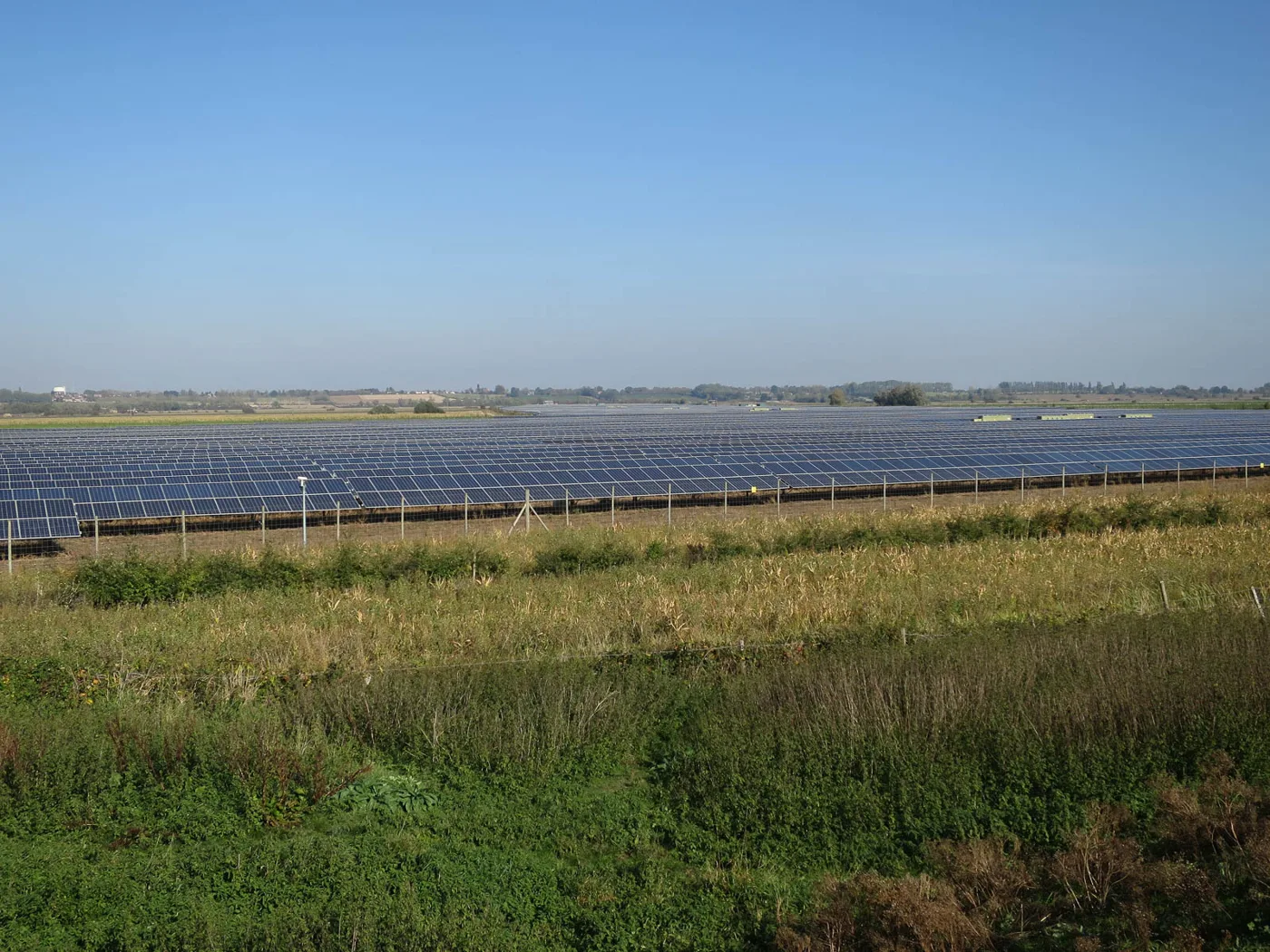

Brentwood's committee approved the 49.9MW Shenfield scheme 6 to 5 after a refusal motion failed. The permission runs 40 years and no community fund is secured.
The 49.9MW solar farm and battery storage scheme at Fitzwalters Farm on Roman Road, Shenfield was approved by a single vote. Brentwood Borough Council’s Planning Committee first voted on a motion to refuse application 25/00813/FUL against the officer recommendation, and lost it five votes to six, before approving the scheme by the same margin in reverse. (Planning Committee minutes, 21 July 2026)
The council’s own announcement of the decision four days later did not mention how close the vote was. The minutes, published since, record it in full.
Voting to refuse: Cllrs Bakhsh, McCheyne, Parker, Patel and Thomson. Voting against refusal, and then to approve: Cllrs Mynott, M Cuthbert, Baldock, Dr T Barrett, Gorton and Rigby. There were no abstentions in either vote.
What has been permitted
The permission covers ground-mounted solar panels capable of generating up to 49.9MW at full capacity, a battery energy storage system of the same 49.9MW rating, inverter platforms, a control room, a substation, security fencing, CCTV and a temporary construction compound. The application site runs to about 95.35 hectares. (Officer report to committee)
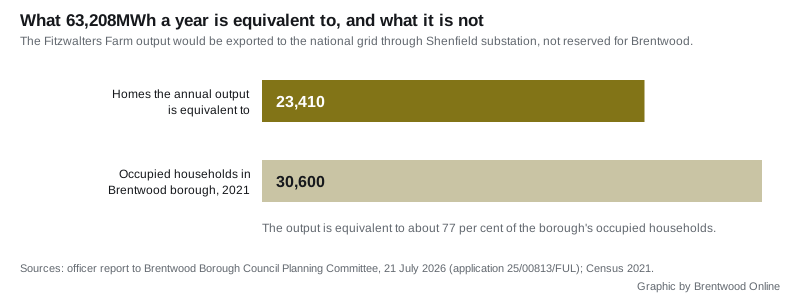
The officer report puts estimated output at 63,208MWh a year, which on the government’s average domestic consumption figure equates to 23,410 homes. The report is careful about what that means: the electricity would be exported into the distribution network through Shenfield substation “rather than reserved for local consumption”. For scale, the borough had 30,600 occupied households at the 2021 census, so the output is equivalent to about 77 per cent of Brentwood’s homes, not a supply to them.
Permission is temporary. The site can operate for up to 40 years, after which the panels, batteries and infrastructure must be removed and the land restored. Officers told members that responsibility for decommissioning and restoration runs with the land and stays with the landowner.
Why the Green Belt argument did not stop it
The site is Green Belt, and the council’s own 2018 Green Belt Study rates the wider parcel it sits in as making a high overall contribution to Green Belt purposes. Officers assessed the specific site rather than the parcel and concluded it is grey belt under the updated National Planning Policy Framework, that paragraph 155 is successfully engaged and that the development is therefore “not inappropriate within the Green Belt”.
That conclusion carried a consequence beyond the committee room: because the scheme was not treated as inappropriate development, the officer report records that referral to the Secretary of State under the 2024 consultation direction was not required. The decision stopped in Brentwood.
On farmland quality, the submitted survey classifies the site as predominantly Sub-Grade 3b, with about 8.3 hectares of Sub-Grade 3a, which counts as Best and Most Versatile agricultural land.
The biodiversity case weighed heavily the other way. The applicant’s assessment, using the statutory DEFRA metric, claims gains of 137.52 per cent in habitat units, 68.21 per cent in hedgerow units and 23.15 per cent in watercourse units, far above the statutory 10 per cent minimum, through species-rich grassland, wildflower margins and native hedgerow planting.
Who spoke against it
The council’s records show 91 individual contributors made representations, comprising 81 objections, three expressions of support and a small number of general comments.
At committee, a local resident objected on grounds including Green Belt, harm to wildlife and birds, the site forming part of a medieval and Roman settlement, landscape harm, the loss of lakes and fishing, and the loss of land used by community groups including schools and Brownie packs. Cllr Kirsty Dale, chairman of Mountnessing Village Council, objected citing prime Green Belt land, traffic and noise. Cllr Nicholson, who led a petition and represents a neighbouring ward, raised the green and grey belt assessment, cumulative Green Belt loss, whether alternative sites had been established, and fire safety. Cllr Thomas Gordon, ward member for Shenfield, raised food production, wildlife, battery fire safety and construction traffic, and questioned whether the fire service has the equipment to deal with a large battery fire. Written statements from Cllr Sankey and Cllr Worsfold raised similar concerns.
Speaking for the applicant, Luminous Energy said expert findings showed limited landscape effects alongside significant ecological gains, and that the scheme is temporary and reversible after 40 years. The chair reiterated that no statutory consultee objected to the scheme.
Cllr Philip Mynott, chair of the Planning Committee, said afterwards: “There was a comprehensive debate on a motion for refusal against officer recommendation, but robust reasons to justify refusal were not forthcoming.”
The community fund is a goodwill gesture, not a condition
One exchange in the debate matters for anyone expecting local money from this. Members asked about the community fund and whether a decommissioning bond had been secured. Officers advised that conditions are in place to ensure restoration under a decommissioning scheme, but that the community fund “was a good will gesture and not secured through a legal obligation”. The developer’s own project page says a community benefit fund “would be agreed prior to construction” and paid annually during operation. (Luminous Energy, Fitzwalters)
Three conditions were added at the meeting. External colours and finishes of all above-ground equipment, including battery units and fencing, must be approved before installation. The operator must tell the council within 28 days of the date development starts. And if no electricity has been exported to the network within 24 months of commencement, a full decommissioning and restoration scheme must be submitted within six months and implemented within a year of approval, so a half-built site cannot sit there indefinitely.
Two informatives were also agreed: that semi-mature planting should be considered at visually sensitive locations to make screening work sooner, and that the construction traffic management plan should route lorries to avoid the residential parts of Mountnessing and Ingatestone, with access via Roman Road, agreed with Essex County Council as highway authority and National Highways.
What it means for you
If you live in Mountnessing, Ingatestone or Shenfield, the traffic question is the one to watch. The routing is not fixed by the informative; it is settled when the council approves the construction traffic management plan required by condition 9. That approval is the point at which to comment.
Nothing is being built yet. Luminous Energy’s own timeline has construction starting in 2028, and the permission carries a standard three-year commencement condition. The 40-year clock starts when the site begins operating, not now.
If you want to read the papers yourself, the officer report and minutes are on the council’s committee site, including the site location plan. We track new applications in the borough on our Brentwood planning news page.
Have your say